
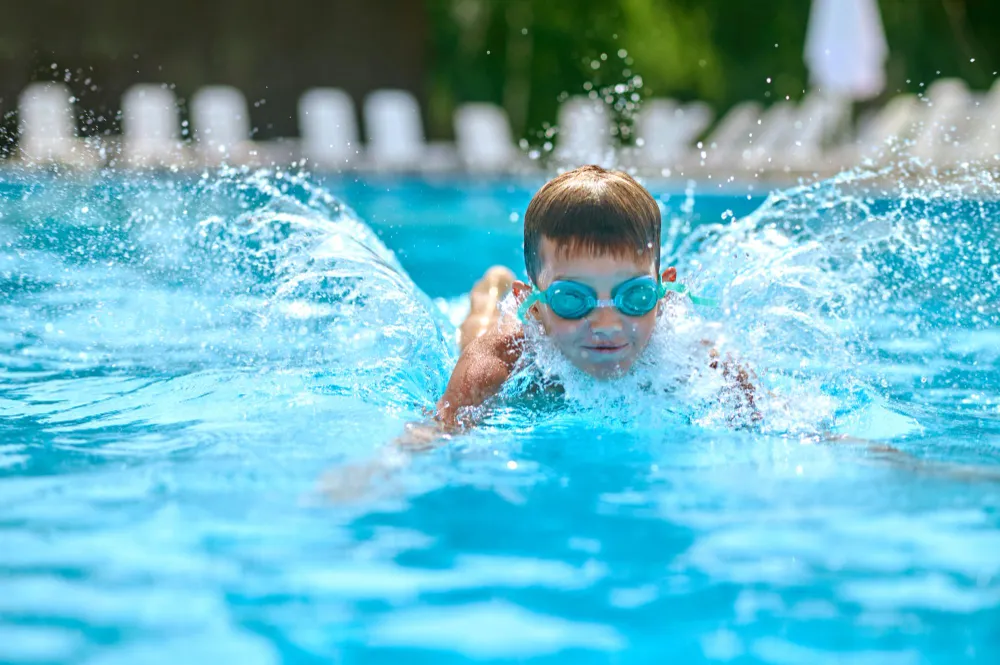
A surprising number of children arrive at their first swimming lesson already convinced the water is the enemy. They cling to a parent’s leg at the pool edge, refuse to sit on the steps, and the half-hour lesson becomes a slow negotiation rather than a teaching session. Coaches expect this; we work patiently around it. But it does not have to start that way. Most of the resistance you see at a first lesson was learned at home, often unintentionally, and most of it can be undone the same way.
This piece is the at-home companion to two earlier articles on this site, one on the specific water safety skills children should learn, and one on the water survival framework that underpins them. Skills sit on top of comfort. A child who is water confident before formal lessons begin will progress faster, enjoy the process more, and reach genuine competence at a younger age. Building that comfort is largely a parent’s job, and the steps are simpler than most parents realise.
What “water confident” actually means
It is not the absence of fear. Many adult swimmers are mildly nervous in deep water, and that is healthy. Water confidence in a child is the settled bodily comfort that says: water is interesting, not dangerous; my breathing is mine to control; if my face gets wet, nothing bad happens. It is built through repeated, positive, low-pressure exposure to water in increasing variety, until water stops being a special category and becomes part of normal life.
The marker of a water confident child is not how far they can swim. It is what they do when something unexpected happens. A confident child whose face accidentally goes under in the pool will surface, splutter, and keep playing. An anxious child will surface, panic, and refuse the pool for a month. The skill is the same. The relationship to the experience is what differs.
Why some children resist water
Three mechanisms drive most water resistance in young children, and understanding them changes how you respond.
Sensory and vestibular. Water alters every sensory input at once. Sound is muffled. Vision is blurred. Temperature shifts. Most importantly, the vestibular system — the inner-ear mechanism that tells the brain which way is up — works differently in water because buoyancy reduces the gravitational cues it normally uses. For children whose vestibular processing is still maturing, this disorientation can be genuinely distressing. It is not naughtiness. It is a developing nervous system trying to make sense of a new physical environment.
Learned association. A single negative water experience can imprint quickly at young ages. Water in the eyes during a forced shampoo, an overzealous splash from a sibling, a slip in the bath, a moment of being held under by a well-meaning relative. The brain encodes the experience as a category, not a one-off, and the child generalises from one event to all water.
Parental transmission. This is the under-discussed one. Children read the bodies of the adults closest to them with high precision. A parent who tenses at the pool edge, whose voice tightens when the child gets close to deeper water, who hovers anxiously rather than sitting calmly nearby, transmits all of that without saying a word. In Malaysia, where many parents never learned to swim themselves, this transmission happens constantly and invisibly. The most useful thing many parents can do for their child’s water confidence is examine their own.
The step-by-step plan
The progression below is built around the principle of small, calm, repeated exposure. Each stage should be comfortable, often joyful, before the next one starts. Rushing produces setbacks. Patience produces lasting confidence.
Stage 1: Start in the bath
Bath time is the unrecognised foundation of Malaysian water confidence. For toddlers and pre-schoolers, the bath is where the first relationship with water is built, and small choices change everything.
Make bath time longer and more playful than purely functional. Let your child pour, splash, and submerge floating toys. Offer cups they can fill and tip over their own hands and arms. Sing through the wash so the rhythm of water contact becomes pleasant rather than something to be endured. Crucially, never force water onto the face. Wait for the child to invite it, then make it small and quick at first.
For hair washing, switch from pouring water directly over the face to using a flannel pressed gently against the forehead, then graduating to a small cup poured backward over the head while the child tilts back. The aim is to break the link between water on the head and discomfort.
Stage 2: Move to the shower
Once the bath is genuinely happy territory, introduce a brief, child-controlled shower. Hand them the shower head and let them spray their own arms, then their tummy, then, eventually, their face. The principle is agency. A child who controls the water is far less afraid of it than one having water done to them.
Most Malaysian homes have showers warm enough for this to be comfortable. Keep sessions short at first. The goal is not to bathe, it is to extend the child’s comfort range one small experience at a time.
Stage 3: Get to the pool, but stay shallow
Take your child to a calm, shallow pool environment before lessons begin. A hotel kiddie pool on holiday, a friend’s pool on a quiet afternoon, the shallow end of your condo pool when it is empty. Avoid busy public pools at this stage; the noise and movement of strangers can overload a child still building comfort.
Sit on the steps together. Splash gently. Walk along the wall holding hands. Let the child set the pace. Many parents make the mistake of seeing pool time as productive only if the child is “doing something.” For a water-shy child, sitting on the steps for twenty minutes laughing at floating toys is doing something. It is the most important thing.
Stage 4: Build to face-in-water
This is the threshold most children resist most, and it is the gateway to genuine confidence. The skill is breath control, but the bigger work is the comfort of having water touch the eyes and nose without panic.
Start dry, on the pool deck or in the bath: blow bubbles in a cup of water. Then in cupped hands. Then with the lips just below the surface. Then with the nose just below. Then, briefly, with eyes open underwater wearing goggles. Each step happens only when the previous one is settled.
Goggles are a genuine confidence accelerator for many children. They remove the eye-sting concern and let the child see what is underwater, which is usually less frightening than what they imagined. There is no shame in using them; many strong adult swimmers wear them too.
Stage 5: Float with assistance
A floating child is a calm child, and floating teaches the body’s most important water-confidence lesson: water will hold you up if you let it. Start with the child held under the head and lower back, lying on their back, looking at the sky. The parent’s job is to be steady, calm, and quiet. Talk gently. Let the child feel buoyant for ten seconds, then sit them back up. Build duration slowly over many sessions.
A front-supported float can follow once the back float is settled. The mechanics are the same; the comfort progression is what matters.
Stage 6: Submerge briefly, under their own control
Once face-in-water is comfortable, brief voluntary submersion is the next step. The child holds your hand, counts to three with you, and dips just below the surface for a second. They surface, you celebrate, you do it again. Over time, the count becomes longer and the parent assistance becomes lighter.
Never force a submersion. The single biggest cause of long-lasting water fear in children is being put under by an adult who thought they were helping. The child has to choose it, even if the choice is small.
Stage 7: Move to structured lessons
By this point, your child is genuinely water confident in the meaningful sense. They are comfortable in water, they have basic breath control, they will float supported, and they will submerge briefly when they choose to. They are ready for formal lessons, and they will progress through them far faster than a child who arrived without this foundation.
This is where a structured swimming programme takes over. Good coaches will continue to build confidence alongside skills, in small classes that allow the kind of patient attention every young swimmer needs.
What parents should not do
A short list, because the negatives matter as much as the positives.
Do not throw a child into water “to make them learn.” This is a Malaysian cultural reflex in some families and it produces deep, often lifelong water phobia. Forced exposure does not build confidence; it builds avoidance.
Do not bribe with rewards. “If you put your face in, you get sweets.” This trains the child to associate water with effortful negotiation, which is the opposite of comfort.
Do not narrate your own anxiety. “Be careful, the water is dangerous, don’t go too far.” A child reads urgency far more than content. Calm presence beats verbal warnings every time.
Do not compare with siblings or other children. “Look how brave your sister is.” Confidence develops on individual timelines, and shame interferes with the process more than parents realise.
Children with sensory or developmental differences
The principles above apply to every child, but the pace and approach often need adjustment for swimmers with autism, ADHD, sensory processing differences, or asthma. Sessions should be quieter, more predictable, and more visual. Familiar coaches matter more. The first session is often a meeting before it is a lesson, where the coach and parent talk through triggers and goals before any water contact happens.
Our special needs programme covers this approach in detail. Most children who struggle in standard group lessons thrive in a private one-to-one or two-to-one format until water comfort is genuinely established, and many integrate into small groups later.
The role of structured lessons
Home-built water confidence is foundational, but it has a ceiling. At a certain point your child needs water teaching from someone who is not their parent, in a setting where the work can progress methodically. This is where a proper learn to swim programme earns its place.
What you are looking for in a programme: small classes, certified coaches, and a structured progression that respects each child’s pace. The Long-Term Athlete Development framework most credible swim schools follow is built around the same principle that produces water confidence at home — small, sequential, mastery-based steps, with no skill rushed before the underlying comfort is in place.
Frequently asked questions
1. At what age should I start building my child’s water confidence?
The bath stage begins from the start of bath time itself, which means months old. Pool stages typically begin around two to three years old, depending on the child’s temperament and your access to a calm pool environment. Formal lessons usually start from age three.
2. My child screams every time water touches their face. Is something wrong?
Almost certainly not. Strong face-water aversion is common in toddlers and pre-schoolers and is rarely a sign of any deeper issue. It responds well to the gradual, child-controlled approach above. If the aversion is severe or paired with other sensory difficulties, a private session with a coach experienced in working with sensory differences is often a better entry point than a group class.
3. What if I cannot swim myself?
You can still build your child’s water confidence in shallow water without being a swimmer. Stay within standing depth, prioritise calm presence over technique, and consider booking adult lessons of your own. Your visible confidence in water genuinely changes your child’s outcomes.
4. How long does it take a water-shy child to become confident?
For most children with consistent gentle exposure at home plus weekly structured lessons, water confidence settles within three to six months. Some children take longer; a few are confident in weeks. Pace matters less than consistency.
When your child is ready for the lesson side of the journey, a short skill assessment with one of our certified coaches will identify exactly where they are and the right pace to start them at. Book an assessment at our Klang, Shah Alam or Puchong venue when the time is right for your family.