
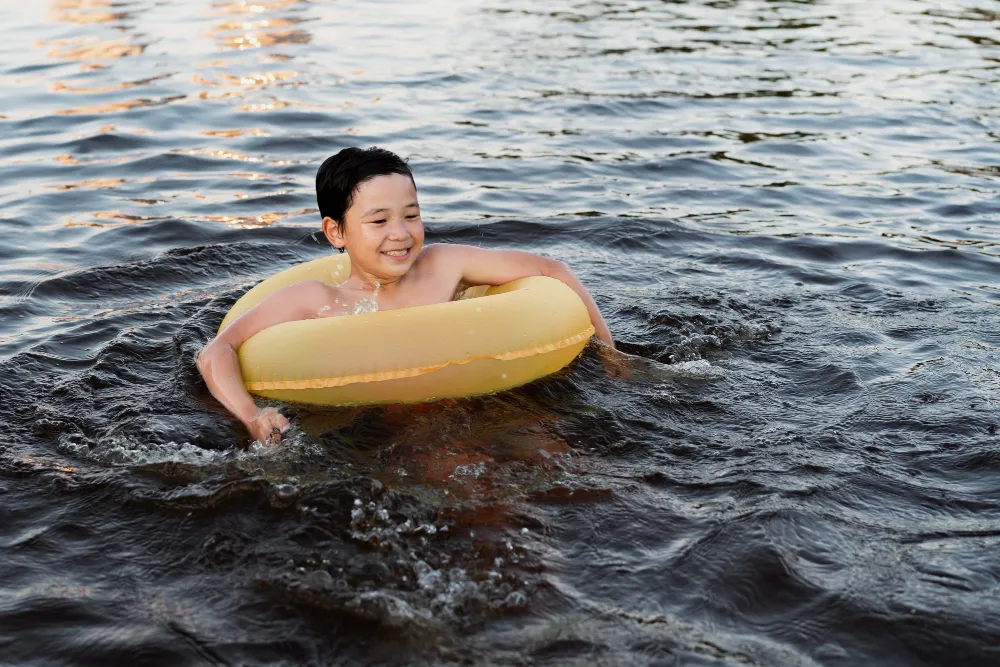
There is a moment, repeated thousands of times every year in Malaysia, that almost no one outside the lifeguarding profession knows how to recognise. A person slips into water that is deeper than expected, instinct takes over, and within twenty to sixty seconds they are either above the surface and breathing or they are not. The interval is that short. The signs are quieter than parents are led to believe. And the difference between the two outcomes is rarely how well the person could swim a pool length, but whether they had any genuine water survival capability at all.
This piece is about what survival in water actually means, what the body does when it loses control in water, and the framework that competent swim education uses to build survival capability layer by layer. It is the companion to our earlier piece on the specific water safety skills children should learn. That one is the curriculum. This one is the why. accept children from three years old, which is when language comprehension and motor coordination are typically sufficient for water instruction. Earlier than this, parent-and-child water familiarisation sessions can build comfort, but formal skill teaching usually begins at three.
Survival is not the same as swimming
A useful starting distinction. Swimming is moving efficiently through water for a purpose, usually distance, sport, or fitness. Survival swimming is the much narrower ability to stay alive when something in the water has gone wrong: an unexpected fall, sudden fatigue, a cramp, a current pulling against the swimmer, a moment of disorientation in deep water.
Most Malaysians who would describe themselves as “able to swim” can manage the first set of conditions. Far fewer have practised the second. A 2024 study of 525 Malaysian adolescents found that 57% could not swim at all and only 17% described their swimming as adequate, which tells you how thin the local baseline already is. Within that small competent group, survival capability is thinner still. The reason is straightforward: most swim lessons in Malaysia teach forward movement first, and survival capability second, if at all.
The order should be reversed. Survival is the floor. Stroke work is the building above it. A swimmer without survival skills is a tourist in their own competence.
What actually happens when someone is drowning
Most people picture drowning as it appears on television: arms waving, shouts for help, splashing visible from a distance. The reality is almost the opposite, and the misconception kills people.
The phenomenon is called the Instinctive Drowning Response, first described in research by Dr Frank Pia, a former US Coast Guard lifeguard whose work changed how lifeguards are now trained globally. Five features matter:
Drowning is silent. A drowning person physically cannot call for help. The respiratory system has one job at that moment — getting air in and water out — and speech requires breath the body cannot spare.
The arms are not waving. They are pressing down on the water, instinctively, trying to lever the mouth above the surface. A waving gesture requires conscious control the drowning brain no longer has.
The body is vertical, not horizontal. A drowning person is upright in the water, often with no apparent kicking motion. The head is tilted back, the mouth at or just above water level.
The face shows almost no expression. The eyes may be open, glassy, or closed. The mouth may be sinking and resurfacing in a rhythm that looks like the person is bobbing for breath.
The struggle lasts twenty to sixty seconds at most. For a child, often only twenty. After that, the person submerges. There is no second chance to notice.
This is what every parent and every swim teacher should know by heart. The image of the dramatic, splashy drowning is wrong, and people who go looking for it are looking past the actual one. Once you have seen the Instinctive Drowning Response described properly, you cannot unsee it at a pool deck again.
The survival framework: float, swim, float
Global lifesaving bodies — the YMCA, Red Cross, Royal Life Saving Society, and our own Life Saving Society Malaysia (LSSM) — have converged on a survival sequence that works for most accidental water situations. It is taught in different schools under different names, but the spine is the same.
Stage one: float to recover. The first instinct in trouble should be to stop fighting the water and float. On the back, ideally, where the airway is unobstructed and breathing is easy. The body is more buoyant than most people realise, even in fresh water, and a relaxed back float can be held by most competent swimmers for several minutes with almost no effort.
Stage two: assess. Once breathing is controlled, the swimmer scans for the nearest safe destination: a pool edge, a shoreline, a boat, a floating object, a buoyant aid being thrown to them. Panic shrinks the search; calm expands it.
Stage three: swim to safety. A controlled stroke, head up if needed to keep visual contact with the target, breathing on every cycle if necessary. The stroke does not have to be pretty. It has to be sustainable.
Stage four: float if tired. If the distance is greater than the swimmer’s current stamina, return to a float, breathe, then continue. The pattern repeats.
This sequence is what separates a survival-trained swimmer from one who has only been taught strokes. It is also why every well-designed learn to swim ladder covers floating before forward movement, and revisits it at every level afterwards. Floating is not a beginner skill that you graduate from. It is the survival foundation that everything else stands on.
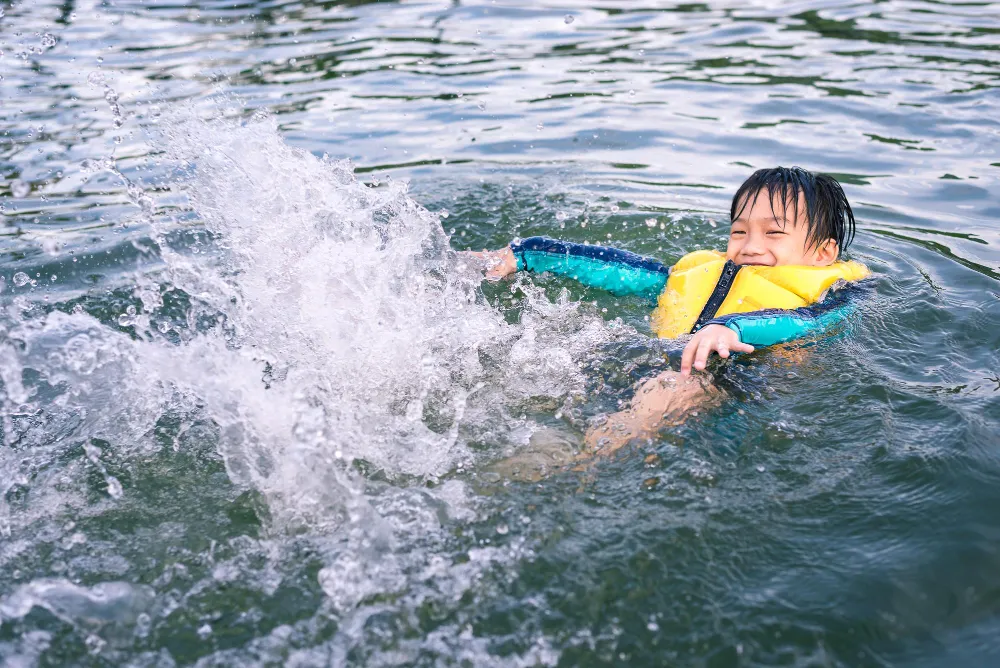
The five components of water competency
The Red Cross and several international aquatic bodies use a more formal framework called water competency. A person is considered water-competent when they can:
- Enter water that is over their head and return to the surface under their own power.
- Float or tread water for at least one minute.
- Turn around and reorient toward safety from any position.
- Swim at least 25 metres of continuous forward movement.
- Exit the water without assistance.
The five sound simple. They are surprisingly rare. Most Malaysian adults could not pass all five today, including many who would tell you they can swim. The benchmark is set deliberately low so that competence is achievable for most people with a few months of structured instruction. The point is not athletic ability. It is the survival baseline beneath which a person is genuinely at risk in any deep-water situation.
Survival in the water Malaysians actually face
Most international writing on water survival is built around two scenarios: backyard swimming pools and ocean coastlines. Malaysia presents a wider set, and survival training that does not account for them is incomplete.
Floodwater. Every monsoon season produces flood events across Pahang, Kelantan, Terengganu, Johor and parts of Selangor, with flash floods becoming more frequent in urban areas including Kuala Lumpur. Flood survival is its own discipline: water is murky, current is strong and irregular, debris is hidden, and the temperature drop from cool rain plus prolonged immersion can fatigue a swimmer fast even in tropical conditions. The survival priority in floodwater is to get out of it, not to swim through it. Keep clothing on for insulation, stay with any floating debris large enough to hold, and angle toward shore on the diagonal rather than fighting the current head-on.
Rivers. Malaysian drowning research identifies seas and rivers as the most common drowning sites for all ages. River survival demands respect for current: the surface looks calm where the bottom is dangerous, and underwater obstacles snag swimmers who cannot see them. Children should never enter moving water alone, and adults should treat unfamiliar rivers with the assumption that the current is stronger than it appears.
Tropical sea. Malaysian coastal water is warm, which removes the cold-shock risk that dominates temperate-water survival writing, but introduces others: rip currents along certain stretches of Pahang, Terengganu and Sabah, jellyfish in season, and fatigue from sun and salt over time. Rip current survival is counter-intuitive and worth knowing: do not swim against the current toward shore. Swim parallel to the shore until out of the rip, then angle in.
Hotel and condominium pools. The most common Malaysian swimming environment is also the one parents underestimate most. Malaysian regulation requires lifeguards only when a hotel pool exceeds a certain depth, and many condominium pools fall outside that requirement entirely. The lifeguard you assume is present often is not. Active parental supervision is the default safety system, not a backup to it.
Children, adults, and the survival capability gap
Survival capability does not develop on the same timeline for every age. The patterns matter.
Toddlers and pre-schoolers. Drowning risk is highest in this group. The Instinctive Drowning Response runs through faster, often inside twenty seconds. Survival capability at this age is mostly the product of structured, repeated water familiarisation: breath control, back floating, and the ability to roll from front to back for air. These skills can be built reliably from about three years old.
Primary-school children. This is the developmental window where survival capability moves from “can be rescued” to “can self-rescue.” Treading water for a minute, swimming 25 metres, exiting safely. A child who can do these three reliably is operating at the water-competency baseline.
Adolescents. Drowning in Malaysia peaks in the 10 to 14 age bracket, and is over three times more common in boys than girls, largely because adolescents overestimate their capability and seek out water environments their skills do not match. Adolescent survival training is partly skill and partly judgement: knowing what you can and cannot handle. Confidence without competence kills disproportionately at this age.
Adults. Most adult drowning victims in Malaysia knew how to swim, in the loose local definition. What they often did not have was practised survival capability in the specific environment that overwhelmed them. Adults who learn to swim or refresh their swimming as adults benefit enormously from a survival-first curriculum, particularly if they spend time near sea or rivers.
Swimmers with different developmental profiles. Children with autism, ADHD or asthma develop survival capability on a different curve, but it is reachable with the right pedagogical approach. The skills are the same; the pace and sensory environment are adapted. We cover this in detail in our special needs swimming page.
What “survival-ready” actually looks like
A few markers that separate a survival-capable swimmer from a swimmer who happens to know strokes:
- They can float on their back without effort for a minute or longer, breathing normally.
- They can submerge unexpectedly and resurface calmly, without reflexive inhalation.
- They can tread water for at least a minute without losing head position.
- They can swim 25 metres continuously, head up if needed, breathing on every cycle.
- They have a settled mental response to water that does not go as planned, built only through repeated, controlled exposure to the unexpected.
That last one matters most and is the slowest to develop. It is built through years of consistent practice, structured progression, and a coaching team that revisits survival work at every level rather than treating it as something beginners outgrow.
Frequently asked questions
1. Is water survival the same as learning to swim?
No. Swimming is forward movement through water, usually for a purpose. Water survival is the narrower set of skills that keeps a person alive when something in the water goes wrong. A swimmer can be a strong front-crawl mover and still lack survival capability. The two should be taught together, but they are not the same.
2. At what age should water survival skills start?
Most structured programmes accept children from three years old, which is when language comprehension and motor coordination support the early survival skills (breath control, back floating, rolling). Earlier than that, parent-and-child familiarisation builds comfort, but formal survival teaching usually begins at three.
3. How long does it take to become genuinely water-competent?
With consistent weekly lessons in a small-class setting, most children reach the five-skill water competency baseline within twelve to eighteen months. Adults starting from zero often reach the same standard in six to twelve months, with private one-to-one sessions producing faster results.
4. What is the most useful single survival skill if I can only learn one?
The back float. A swimmer who can hold a relaxed back float indefinitely has a survival option in almost any deep-water situation. It is also the easiest skill to practise, requires no equipment, and stays with the body for life once properly learned.
Survival is the part of swimming worth taking seriously, and it is more learnable than most parents realise. A short skill assessment with one of our certified coaches will identify where your child or you currently stand on the survival baseline, and what the next sensible step is. Book an assessment at our Klang, Shah Alam or Puchong venue when you’re ready.