
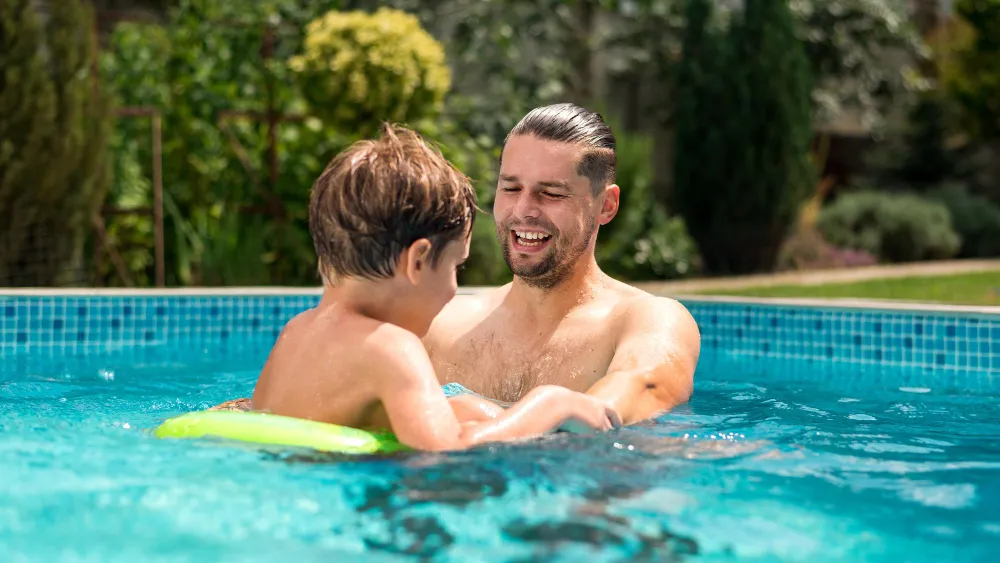
The numbers Malaysian parents rarely see are the ones that should change how we think about swimming. An average of 286 children die from drowning in Malaysia each year, with another 207 surviving but injured, an annual rate of around 5 per 100,000 children. Most incidents happen in seas and rivers, peak during the monsoon, and are over three times more common in boys than in girls. The harder truth: a 2024 study of 525 Malaysian adolescents found that 57% could not swim at all, and only 17% described their swimming as adequate.
This is the country your child is growing up in. Condo pools, beach holidays in Port Dickson and Langkawi, school excursions to waterfalls, kampung trips with rivers cutting through. Water is everywhere here, and competence in it is not something Malaysian children inherit by default. Water safety skills are not optional life skills for a generation that will spend more time near water than any before it. They are foundational, and they have to be taught.
The good news is that the global framework for what to teach is well-established. The Red Cross, the YMCA and the World Health Organization have converged on a small set of competencies that genuinely reduce drowning risk. The skills below blend that framework with what Malaysian conditions demand, in the order most paediatric swim educators teach them.
Why “can swim” is not the same as “water competent”
Many parents in Malaysia describe their child as able to swim if the child can move from one end of a pool to the other. Survival research uses a different bar. The accepted standard for water competency is whether a child can survive an unexpected fall into deep water, get to safety on their own, and exit unaided. By that measure, even children who attend a few terms of lessons often fall short, because most casual swimming instruction teaches movement, not survival.
The skill list that follows reflects what competent looks like. Some are taught in the first few lessons. Others develop over years as part of a structured progression. The order matters: each one builds the foundation for the next.
The core water safety skills, in the order children learn them
1. Water familiarisation and breath control
Before a child can be taught anything else, the water has to stop being frightening. Most well-designed learn to swim programmes spend the first sessions on what feels like play: splashing, gentle face-dipping, blowing bubbles, sitting on the steps. This is not filler. It is the foundation that everything else stands on.
The specific skill being built is breath control. A child who can exhale through their nose and mouth underwater on demand has the single most important physiological skill for survival. Children panic in water primarily when their breathing pattern is disrupted, and a child who has practised exhaling underwater hundreds of times is far less likely to inhale at the wrong moment. The drill is simple: blow bubbles, lift to breathe, repeat. Done consistently, it becomes automatic.
2. Floating on the back and front
Floating teaches a child that the water will hold them if they let it. This is counterintuitive for most children, whose instinct in deep water is to thrash vertically, which sinks them.
The back float is the survival float that matters most. A child who can hold a relaxed back float for a minute, breathing normally, has bought themselves rescue time in any unexpected water situation. The front float is taught alongside, because most accidental water entries put a child face-down first, and the ability to right oneself from front to back is its own skill (see below). Coaches typically introduce supported floats in the early lessons, then progressively reduce assistance until the child can hold the position unaided.
3. Roll from front to back for air
This is the single most underrated water safety skill, and it saves lives. A child who falls into water face-down will instinctively try to lift their head to breathe. That instinct is exhausting and quickly unsustainable. The correct response is to roll onto the back, where breathing is free and effort is minimal.
Teaching the roll requires deliberate practice. Coaches usually progress from supported rolls in shallow water, to unsupported rolls with a kick, to the full sequence: front glide, roll to back, breathe, roll to front, continue. It looks small. It is one of the highest-yield interventions in any child’s swimming education.
4. Submerging and returning to the surface
Children need to know what to do when their head goes under, because at some point it will. The skill is not avoiding submersion; it is staying calm during it and reorienting to the surface.
The drill starts in chest-deep water. The child submerges deliberately, opens their eyes, recognises which way is up, and pushes off the bottom or strokes back to the surface. Over time, the depth increases. By the time a competent swimmer can enter water over their head and return to the surface, the foundation of the Red Cross water competency standard is in place.
5. Treading water
Treading is the ability to keep the head above water in a vertical position, without forward movement, for an extended period. It is what a child does while waiting for help in a pool, or while assessing where to swim next in open water.
The technique is a combination of leg sculling, often an eggbeater or flutter kick, and arm sculling. Most children can hold a tread for ten seconds within their first few months of structured lessons. The water-competency benchmark is one full minute without losing the head position. That minute is what separates an alarmed child from a calm one when supervision lapses for a moment.
6. Turn, orient and swim to safety
In an unexpected fall into water, a child often enters facing the wrong way. The next skill is the ability to turn 180 degrees in the water, identify the nearest safe exit (a pool edge, a wall, a shoreline, a flotation aid), and move toward it.
This is taught in pieces: spotting where the wall is from a back float, executing a controlled turn, swimming a short distance with the head up to maintain visual orientation, and reaching the edge. Open water adds the additional skill of sighting against a fixed point, which is closer to the work covered in our open water programme, but the foundation begins in the pool.
7. Safe pool entry and exit
The first and last actions of any swim. Children who climb in and out using the steps and the wall, rather than jumping in unannounced, are far less likely to enter water in a way they cannot manage. Teaching includes sitting entries, controlled jumps with adult presence, and the use of pool walls and ladders for exits.
A useful drill many programmes use is the “crab walk” along the pool edge: the child holds the wall with both hands and moves laterally, learning that the wall is always reachable. It builds upper-body strength and, more importantly, the habit of staying connected to safety.
8. Continuous swimming with breathing
Once the survival skills are in place, swimming for distance becomes meaningful. The water competency standard cites swimming 25 yards (around 23 metres) as the threshold; most structured programmes work toward 25 metres of continuous freestyle with bilateral breathing as a milestone, then build distance and stroke variety from there.
The point is not speed. It is sustainability. A child who can swim 25 metres while breathing properly can swim further at the same effort level, which is what matters when the distance to safety is unknown.
The skills parents need, not just children
A child’s water safety depends as much on the adults near them as on their own competence. Three skills are non-negotiable for any parent of a young swimmer.
Active supervision. Stay within arm’s reach of any weak or inexperienced swimmer, and provide close, constant attention to children near water, regardless of how shallow the water appears. Phones away. Conversations paused. The “drowning is loud” image is false: real drownings are usually silent, vertical, and last less than a minute.
Recognise drowning’s actual signs. A swimmer in real trouble is often not moving forward, may be vertical in the water without treading, and may be face-down or motionless on the surface. They are rarely waving for help; their arms are usually pressing down on the water trying to stay up.
Know basic rescue and CPR. The principle is “reach or throw, don’t go”: extend a pole, a towel, a noodle, or throw a buoyant object. Going in after a drowning person is the most common way bystanders themselves drown. CPR knowledge buys minutes that the wait for an ambulance does not.
When to start, and how skills should progress
Children can begin structured swim lessons in Malaysia from around three years old, which is when most have the gross motor coordination, language comprehension and attention span to follow water instructions safely. Skills are introduced in a deliberate sequence, with movement to the next level based on mastery rather than age.
This is where the Long-Term Athlete Development framework applies. The science behind it is straightforward: children develop in stages, and trying to teach an advanced skill before the underlying foundation is in place wastes time and often creates anxiety. A six-year-old asked to swim a freestyle length before they can blow bubbles reliably is being set up to fail. A six-year-old taken through breath control, floating, rolling and treading first is being set up to succeed at every stroke that follows.
The same logic applies to children with different developmental profiles. A swimmer with ADHD, autism, or asthma benefits from the same skills, taught at the same standard, but with a pace and approach calibrated to how they learn. Our special needs programme covers this in detail.
What good water safety teaching looks like
A few markers separate a programme that genuinely teaches water safety from one that runs lessons:
Small classes. Five or six swimmers maximum. Beyond that, the coach cannot give each child the close attention water work demands.
A documented, milestone-based syllabus. Each level has clear skills the child must demonstrate before moving up. Parents should be able to see what their child is working on, and what comes next, on a structured progression.
Certified coaches who themselves train continuously. Credentials like the LSSM Bronze Medallion or equivalent lifesaving qualifications matter. So does ongoing internal training: a coach’s skill stagnates without it.
Honest assessment of where the child actually is. Most schools place new swimmers based on age. The better practice is a short skill assessment to see how the child moves, breathes and responds in water, then place them at the level that matches.
Frequently asked questions
1. At what age can a child start learning water safety skills?
Most structured programmes accept children from three years old, which is when language comprehension and motor coordination are typically sufficient for water instruction. Earlier than this, parent-and-child water familiarisation sessions can build comfort, but formal skill teaching usually begins at three.
2. How long before my child is genuinely water-safe?
With consistent weekly lessons in a small-class setting, most children reach a basic water-competency standard (float, tread, return to surface, swim 25 metres) within twelve to eighteen months. This varies by individual, and progress is faster in private one-to-one sessions for children who need more focused attention.
3. Are floaties and arm bands enough to keep my child safe?
No. Floatation aids can support early water familiarisation, but they should never substitute for supervision or for the skills above. Children who rely on floaties may struggle when the device is removed, having never learned the underlying body position. Use them sparingly and always with active adult presence.
4. My child knows how to swim. Why do they still need water safety lessons?
Swimming is movement. Water safety is survival. A child who can swim a length may still panic in deep open water, struggle to right themselves from an unexpected fall, or not know how to exit safely. The skills above are taught as a system, and a child can have some of them without having all of them.
Ready to find out exactly where your child stands? A short skill assessment with one of our certified coaches will identify which of the skills above your child already has, which need work, and which level fits them best. Book an assessment at our Klang, Shah Alam or Puchong venue when you’re ready.